Hair Transplant at 29 for Norwood Grade 4: 2,642 Grafts, 6-Month Result
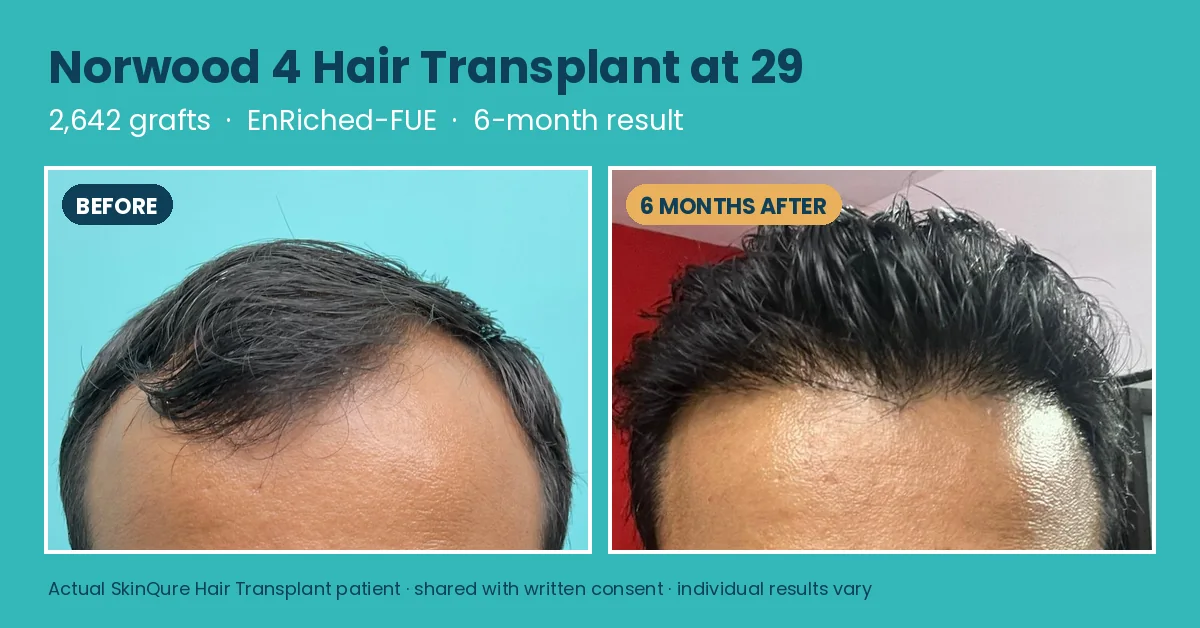
A real case from our clinic: a 29-year-old man with Norwood Grade 4 hair loss, a strong donor area, and a hairline planned for his age and face rather than for the day of surgery.
Quick answer: Often, yes, if the donor area at the back of the head is strong and the plan allows for the fact that hair loss can continue. Norwood Grade 4 means the front and temples have receded deeply and the mid-scalp has thinned, while a band of hair still separates the front from the crown. In this case, 2,642 grafts were placed across the front, temples and middle using EnRiched-FUE™, with 380 single-hair grafts forming a soft, natural hairline. At 6 months the front has filled in, and further improvement is expected over the next 3–4 months. A good result depends as much on donor quality, hairline design and aftercare as on the graft count.
Actual SkinQure Hair Transplant patient. The photographs on this page are of a real patient treated at SkinQure Hair Transplant by Dr. Jangid, published with his written consent. They have been cropped to the scalp so he cannot be identified.
I'm 29 and My Hairline Is Going Back: What the Patient Came In With
The patient, a 29-year-old man, came to us with a receding hairline and deep recession at both temples. The hair in the middle of his scalp had also become thin, so the front of the head looked sparse even when his hair was styled forward. This pattern is common in men in their late twenties, and it is usually the age at which people start asking whether a transplant is possible or whether they are “too young”.
What We Found on Assessment
- Norwood Grade 4 male pattern hair loss: deep recession at the front and temples, with thinning in the mid-scalp.
- A very good donor area. Hair density at the back and sides was high (+++), the individual hairs were thick (+++), and the scalp was normal, with no signs of scalp disease.
- A small, round face. This matters for hairline design: a hairline that is too low or too straight would look out of proportion.
Assessment: male pattern hair loss (androgenetic alopecia), Norwood Grade 4, with a donor area well suited to a transplant.
Case at a Glance
| Age / sex | 29 years, male |
|---|---|
| Hair loss grade | Norwood Grade 4 |
| Donor area | Very good: density +++, hair thickness +++, normal scalp |
| Technique | EnRiched-FUE™ |
| Areas treated | Front, temples and middle of the scalp |
| Total grafts | 2,642 |
| Hairline (transition zone) | 380 single-hair grafts; 95–100% of the hairline made with singles |
| Planned density | Up to 35–40 grafts/cm² at the front, tapering gradually behind |
| Procedure time | About 6 hours in the operation theatre |
| After surgery | No complications; mild swelling for 2–3 days |
| Supportive treatment | Topical medication, plus PRP once a month |
| Result shown | 6 months after surgery; further improvement expected over 3–4 months |
Before and After: 6-Month Result
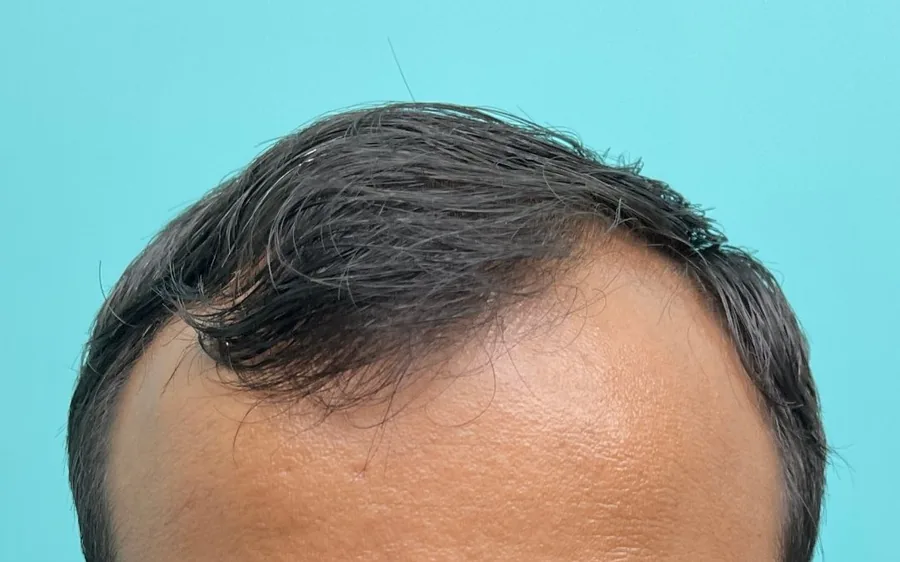
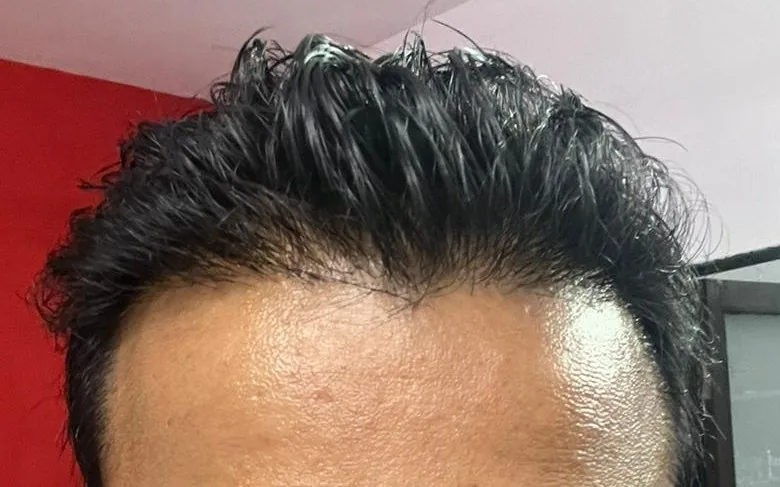
Front view. Before: the hairline has receded at the front and both temples. At 6 months: a new hairline has formed across the front.
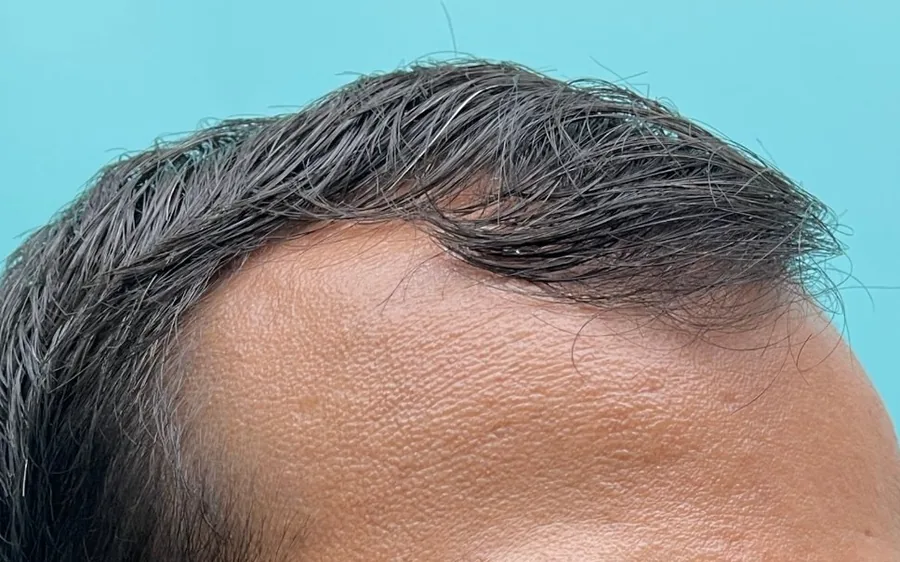
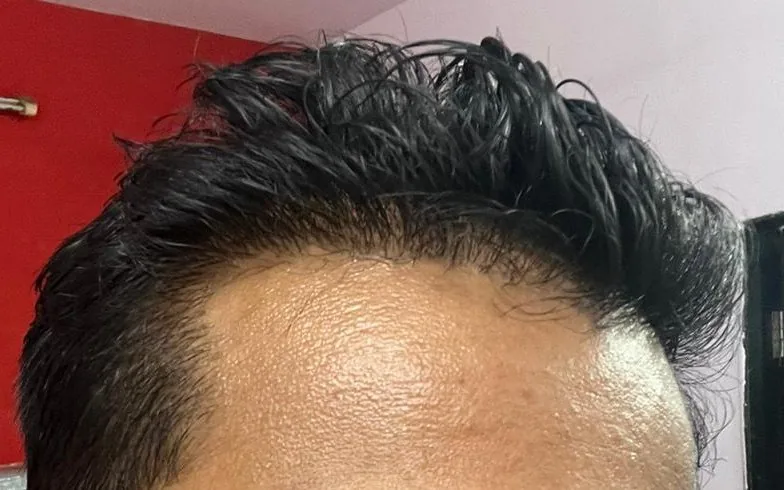
Right side. The deep temple recession has filled in with a gradual, tapered edge.
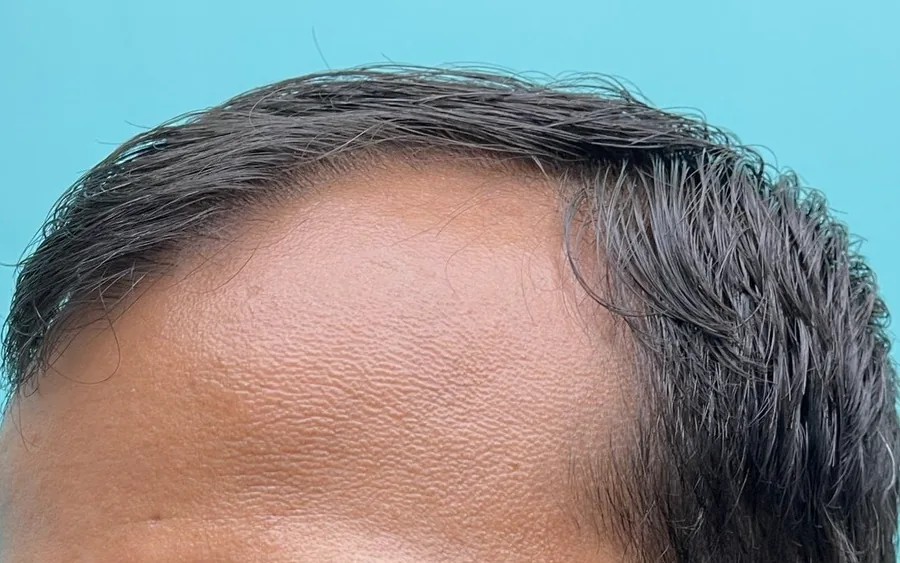
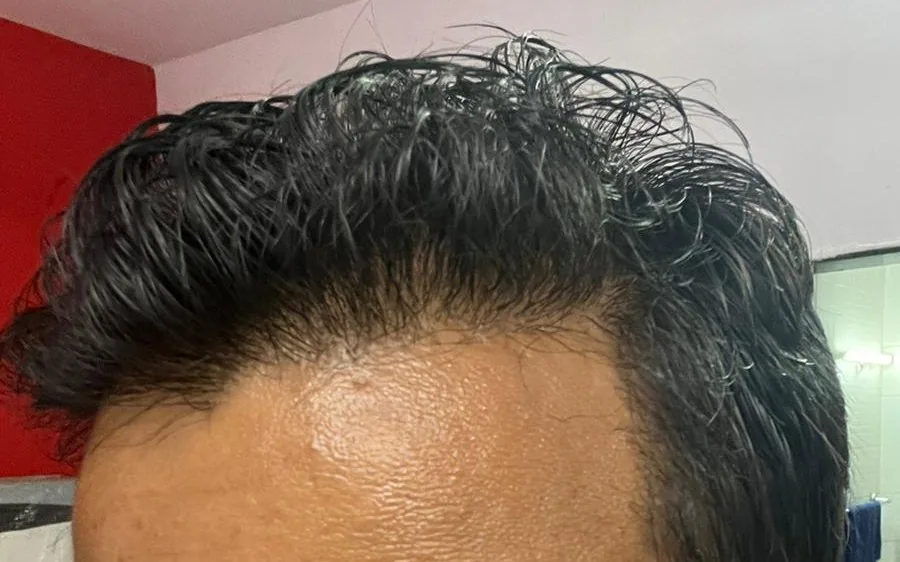
Left side. The temple angle has been rebuilt to suit the patient's age and face shape.
Image disclaimer: These are actual SkinQure Hair Transplant patient photographs, reproduced strictly for educational purposes with the patient's written informed consent. They have been cropped to the scalp to protect his identity and are otherwise unretouched. The “before” photographs were taken at the clinic and the 6-month photographs at home, so lighting and hair styling differ. They show one patient's result; they are not a prediction of yours, and individual results vary. Please consult a qualified doctor for an assessment of your own hair loss.
What Is Norwood Grade 4?
The Norwood scale is the system doctors use to grade male pattern hair loss, from Grade 1 (no real recession) to Grade 7 (only a horseshoe of hair left at the sides and back). At Grade 4:
- The hairline has moved back noticeably at the front, and the temples have receded deeply.
- The crown may also be thinning.
- A band of moderately dense hair still runs across the top of the head, separating the front from the crown.
Grade 4 is a common stage at which a transplant is considered, because the loss is now visible but there is usually still plenty of donor hair. It is also a stage where the loss can keep progressing, which shapes every planning decision. Read more about Grade 4 male pattern baldness.
Why the Donor Area Decided This Case
A hair transplant moves hair; it does not create new hair. The grafts come from the back and sides of the head, where follicles are naturally resistant to male pattern hair loss and usually keep growing after they are moved. So the quality of that donor area sets the limit on what any surgeon can achieve.
This patient's donor area was very good on all three counts that matter: many follicles per square centimetre, thick individual hairs, and a healthy scalp. Thick hair covers more scalp per graft, so the same number of grafts gives a fuller look. It also meant 2,642 grafts could be taken without over-harvesting, leaving donor reserve in case he needs more work in future.
How the Plan Was Made
Three decisions shaped this transplant.
1. A Hairline for His Age and Face, Not for the Day of Surgery
A common mistake in young patients is a low, straight, teenage hairline. It can look good for a year or two and then look unnatural as the person ages and the hair behind it continues to thin. Here the hairline was made age-appropriate: placed and shaped to suit a 29-year-old with a small, round face, so it looks natural now and should still look natural later.
2. Single-Hair Grafts at the Front Edge
A natural hairline is not a sharp line. It starts with fine single hairs and becomes denser behind them. Of the 2,642 grafts, 380 single-hair grafts were placed in the hairline's transition zone, and 95–100% of the hairline itself was made with singles. This is what keeps the front edge soft rather than “pluggy”.
3. Density Where It Shows, Tapered Behind
Grafts were placed at up to 35–40 grafts per cm² at the front, where density is most visible, and the density was then tapered gradually through the temples and mid-scalp. Concentrating density at the front and tapering behind it makes the best use of a limited number of grafts.
The planning principle, in one line: plan the hairline for the face he will have at 45, not just the one he has at 29, and spend the grafts where they make the most visible difference.
What the Treatment Involved
Step 1: Assessment and Planning
Dr. Jangid graded the hair loss, examined the donor area for density, hair thickness and scalp health, and drew the new hairline to suit the patient's face shape and age before surgery.
Step 2: EnRiched-FUE™ Under Local Anaesthesia
FUE (follicular unit extraction) removes individual follicular units, natural groups of one to four hairs, from the donor area and implants them into the thinning areas. With EnRiched-FUE™, SkinQure's FUE technique, extracted grafts are implanted soon after extraction rather than stored for long periods outside the body, and are treated with growth factors before implantation. The procedure took about 6 hours in the operation theatre.
Step 3: Recovery
There were no complications. The patient had mild swelling for 2–3 days, which is common after a hair transplant and settles on its own. He followed his aftercare carefully and came regularly for follow-up visits.
Step 4: Supportive Treatment
A transplant does not stop male pattern hair loss in the hair that was already there. To help protect his existing hair and support the result, he was prescribed a topical medication and monthly PRP (platelet-rich plasma) sessions.
“A classic case of Grade 4 hair loss. A small, round face made it easy to execute, and good hair quality again gives a good result. The hairline was made age-appropriate, and it looks good on his face.”
— Dr. Jangid, MD (Dermatology, Venereology & Leprosy), MBBS
An Honest Caveat
A hair transplant is not right for everyone with Grade 4 loss, and it is not a one-time cure. Native hair can keep thinning after surgery, which is why supportive treatment and follow-up matter, and why some people may need a second procedure years later. A weak donor area, an unstable or very rapid pattern of loss, or certain scalp conditions can make a transplant unsuitable or mean it should wait. The result also takes time: what you see at 6 months is not the final result.
When a Transplant Makes Sense, and When to Wait
| A transplant is often a good option when… | It may be better to wait or treat medically first when… |
|---|---|
| Hair loss has reached a visible stage, such as Norwood 3–5 | Loss is very early or still progressing rapidly |
| The donor area is dense, with healthy hair | The donor area is thin or also affected |
| The scalp is healthy | There is active scalp disease or unexplained shedding |
| Expectations are realistic about density and timeline | The goal is a teenage hairline or a guaranteed final density |
| The patient is willing to continue supportive treatment | Diffuse thinning has another cause that needs treating first |
See also: are you eligible for a hair transplant?
What to Expect Month by Month
| When | What usually happens |
|---|---|
| First few days | Small scabs in the recipient area; mild swelling for 2–3 days is common |
| Weeks 2–6 | Many transplanted hairs shed. This is expected: the follicle stays in place and regrows |
| Months 3–4 | New hairs begin to appear, often fine at first |
| Month 6 | Visible coverage, as in this case; hairs are still thickening |
| Months 9–12 | Most of the final density and texture is usually visible |
For more detail, read the hair growth timeline after a hair transplant.
Where We Are With This Case
At 6 months, the patient's front, temples and mid-scalp have filled in, with a soft hairline that suits his face. He continues topical medication and monthly PRP, and Dr. Jangid expects further improvement over the next 3–4 months. We will update this page after his next review so readers can see the more mature result.
Compare this with other Norwood 4 cases at SkinQure: Norwood 4, 3,150 grafts and Norwood 4, 2,800 grafts, or browse all hair transplant case studies. To estimate your own graft count, try our graft calculator.
Receding at the front or temples? Not sure if a transplant is right for you? Request a consultation with Dr. Jangid at SkinQure Hair Transplant, Saket, New Delhi.
FAQs
1. Is 29 too young for a hair transplant?
Not necessarily. What matters more than age is how stable the hair loss is, how strong the donor area is, and whether the hairline is planned for the future. In this case the hairline was deliberately made age-appropriate, and supportive treatment was started to protect the existing hair.
2. How many grafts are needed for Norwood Grade 4?
It varies with the size of the area, the density wanted and the thickness of the hair. This patient needed 2,642 grafts to cover the front, temples and middle. Thick hair, as in his case, gives more coverage per graft.
3. Will the hairline look natural?
A natural hairline depends on design and on using single-hair grafts at the front edge. Here 380 single grafts formed the transition zone, which keeps the edge soft rather than abrupt.
4. When will I see the result of my hair transplant?
New growth usually starts around months 3–4, coverage is visible by about 6 months, and most of the final result shows between 9 and 12 months.
5. Is it normal for transplanted hair to fall out after surgery?
Yes. Many transplanted hairs shed in the first few weeks. The follicles stay in place and start growing new hair a few months later.
6. Does a hair transplant hurt?
The procedure is done under local anaesthesia, so most people feel the injections at the start and pressure during the procedure. Some soreness and mild swelling for a few days afterwards is common.
7. What is EnRiched-FUE™?
It is SkinQure's FUE hair transplant technique. Grafts are implanted soon after they are extracted, and they are treated with growth factors before implantation.
8. Do I still need medication or PRP after a transplant?
Often, yes. The transplanted hair is resistant to male pattern hair loss, but your existing hair is not. Supportive treatment such as topical medication and PRP helps protect it. Your doctor will advise what suits you.
9. Can hair loss continue after a hair transplant?
The transplanted hairs usually keep growing, but the native hair around them can continue to thin. That is why the plan should account for future loss and leave donor hair in reserve.
Disclaimer: These images feature actual patients of SkinQure and are shared with their informed consent for educational and awareness purposes. Individual results may vary depending on hair loss patterns, donor area, and overall health. Similar outcomes cannot be guaranteed.

Dr. Jangid
Senior Dermatologist & Hair Transplant Surgeon, Ex-Senior Resident at AIIMS, with 18+ years of experience and the originator of the EnRiched-FUE™ approach.
Dr. Jangid, MD - Dermatology, Venereology & Leprosy, MBBS
Registered medical practitioner: Rajasthan Medical Council 025648 · Delhi Medical Council 40715 · Medical Council of India MCI-IMR/09/163