Electric Comb Restored Nearly 98% of Hair in Mice: What the Detangle Study Means
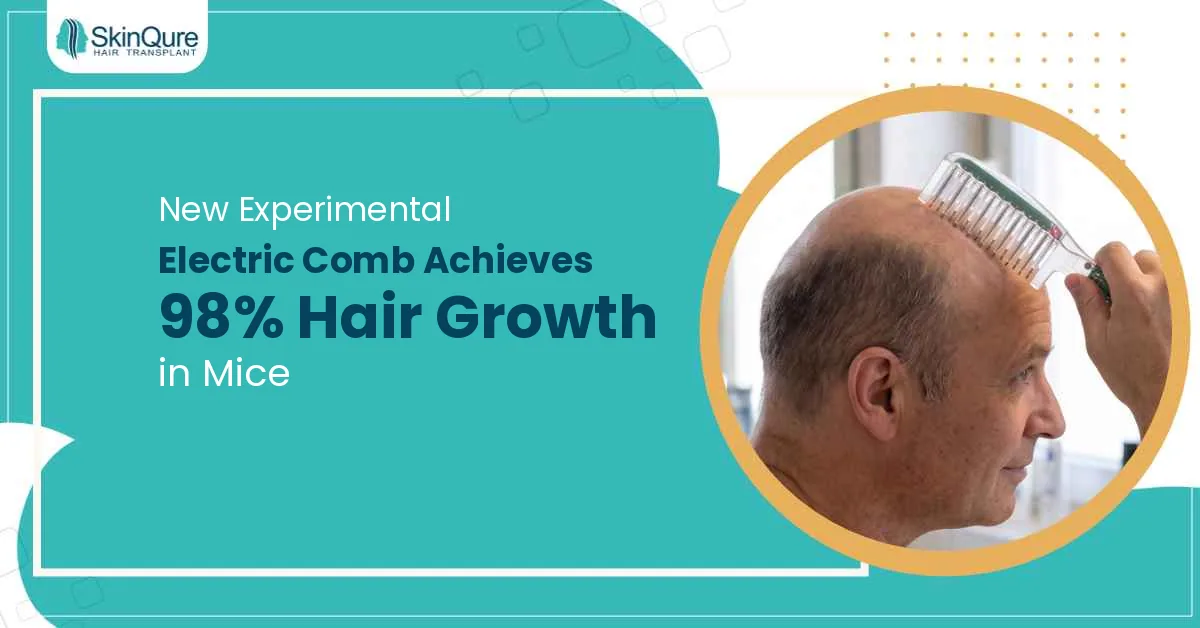
Imagine a comb that does more than detangle hair. What if, while you combed, it also delivered therapeutic molecules to your hair follicles and stimulated the processes linked to hair growth?
That is the idea behind Detangle, an experimental electronic comb developed by researchers in China. In a study published in Nature Communications on 3 November 2026, the team reported about 97.85% hair restoration in mice with androgenetic alopecia within 28 days.
Quick answer: Detangle is a research device, not a treatment. It combines combing, electrical stimulation and the delivery of two experimental genetic molecules, and it restored nearly 98% of hair in a mouse model of pattern baldness. It has not been tested in humans, so its safety and results in people are unknown, and it is not available in India or anywhere else.
Here is who built it, how it works, what the study found, and what it means if you are dealing with hair loss today.
What Is the Detangle Electric Comb?
Detangle is a comb-shaped bioelectronic device designed to stimulate hair follicles and carry therapeutic molecules into deeper layers of the skin. Unlike an ordinary comb, its teeth contain electrodes and drug-loading parts.
It brings together three technologies:
- Mechanical combing: the physical movement of the comb across the skin.
- Electrical stimulation: local electrical pulses that act on the environment around the follicle.
- Targeted molecular delivery: an electrical mechanism that helps therapeutic molecules reach deeper skin structures.
The paper is titled Combing-triggered electrostimulation synchronizing deep delivery for rapid hair regrowth in androgenetic alopecia.
Who Invented the Detangle Hair-Growth Comb?
Detangle was developed by a multidisciplinary team led by scientists at Beihang University in Beijing, working with other institutions including City University of Hong Kong. The work drew on biomedical engineering, biology and medical research.
The authors include Feng Liu, Fuqi Yao, Hong Sun, Yihang Tong, Chunhong Dai, Han Wu, Ruowen Zhang, Dedong Yin, Xiaowei Xiang, Tianhang Feng, Peng Zhang, Zaizai Dong, Lingqian Chang and others. Feng Liu, Fuqi Yao and Hong Sun contributed equally, and the corresponding authors were Yanli Jiao, Zaizai Dong and Lingqian Chang.
So Detangle is a team effort, not the invention of one scientist.
How Does the Detangle Electric Comb Work?
Hair follicles sit inside the skin and respond to many signals, including hormones, blood supply and messages between cells. One long-standing problem in hair research is getting a treatment to the right place: a lotion applied to the scalp does not always reach the follicle in useful amounts. Detangle tries to solve this with electricity.
1. Specially Designed Electronic Teeth
The comb's teeth carry electrodes set at different heights. During combing, this arrangement produces a stronger, more focused electric field. The researchers reported a field about 2.6 times stronger than with evenly aligned electrodes.
2. Electrical Stimulation of Hair Follicles
As the comb moves, it creates short pulses of electricity in the skin. These are meant to act on the cells around the follicle and influence their activity. Stimulation is only part of the story, though: the same field also helps move medicine into the skin.
3. Deeper Delivery Through Electroporation
Detangle uses a process called electroporation. A brief electric field makes cell membranes temporarily more permeable, so certain molecules can enter cells more easily.
In the experiments, this pushed the therapeutic molecules towards the follicle region about nine times deeper than ordinary external application, within a second of combing.
4. Two Experimental Molecules
A. VEGFA plasmid. VEGFA (vascular endothelial growth factor A) is a protein that drives the growth of new blood vessels, called angiogenesis. The plasmid is a small ring of DNA that tells cells to make more VEGFA, with the aim of improving blood supply around the follicles.
B. SRD5A2-targeting siRNA. SRD5A2 is the gene for the enzyme that helps convert testosterone into dihydrotestosterone (DHT). DHT gradually shrinks genetically sensitive follicles in androgenetic alopecia, which is the mechanism behind male pattern baldness. The siRNA is a short piece of RNA that switches this gene down. Medicines such as finasteride target the same pathway in a different way; see how DHT blockers work.
These are specialised experimental genetic tools, not ordinary hair-growth ingredients.
What Did the Researchers Find in the Mouse Study?
Hair loss was induced in male mice with testosterone, and Detangle was applied every three days for 28 days. Different groups received stimulation alone, single molecules, or the full system, so the team could see what each part contributed.
| Study at a glance | |
|---|---|
| Reported hair restoration | About 97.85% of the treated area (full Detangle system) |
| Study length | 28 days |
| Treatment schedule | Every 3 days |
| Model | Mice with testosterone-induced hair loss |
| Comparison groups (mice) | Topical minoxidil about 70%; finasteride about 50% |
| Tested in humans? | No |
The researchers also reported:
- More hair follicles in the treated areas
- Better local blood flow
- Changes in markers linked to blood vessel growth
- The best regrowth when stimulation was combined with both molecules
These numbers come from controlled experiments in mice. They are not a prediction of what would happen on a human scalp, and the minoxidil and finasteride comparisons do not tell us how these medicines perform in people, where both have years of clinical evidence. You can read about how minoxidil is used and minoxidil vs finasteride.
Why Is the Detangle Research Interesting?
The study matters less for the comb itself than for what it shows can be combined in one device.
- Bioelectronics meets hair research: electrical stimulation is built into a tool designed specifically for follicles.
- Targeted delivery: molecules are pushed towards the follicle instead of relying on surface application.
- Two pathways at once: the system acts on blood vessel growth and on DHT-related signalling together.
It sits alongside other early-stage ideas we have covered, such as exosome therapy and the trends in hair transplant in 2027.
Can This Electric Comb Regrow Hair in Humans?
Not yet known. Detangle has only been tested in mice, and its safety and effectiveness in humans have not been established.
Animal studies are a necessary step, but mouse and human skin, hair cycles and hormone responses are different. Several stages of research are still needed:
- Human clinical studies to see whether the same effects happen in human follicles.
- Long-term safety testing of repeated electrical stimulation and of delivering genetic material into skin.
- Treatment settings, such as electrical strength, dose and frequency, that are suitable for people.
- Long-term results, to find out whether any gain in hair density lasts.
Until then, Detangle should be seen as a research device, not a treatment available to patients.
Could This Technology Be Used Beyond Hair Growth?
The researchers suggest the delivery platform could be explored for other skin conditions, since it offers a way to carry molecules into deeper skin layers. These are possible future uses, not established ones, and each would need its own safety research.
What Should You Do If You Are Losing Hair Now?
New research is encouraging, but the first step for anyone losing hair is to find out why it is happening. Common causes include:
- Genetic tendency (pattern hair loss)
- Hormonal changes
- Nutritional deficiencies
- Thyroid disorders
- Autoimmune conditions such as alopecia areata
- Scalp infections and inflammation
- Certain medicines and illnesses, or stress-related shedding such as telogen effluvium
The pattern, speed and length of hair loss give important clues. A dermatologist can examine the scalp, often with trichoscopy, and order tests where needed. See an overview of hair loss causes and the hair loss treatments available today.
Get checked early if you notice sudden heavy shedding, new bald patches, steady thinning or an inflamed scalp.
Conclusion
Detangle, developed by researchers led by Beihang University, is an interesting step in experimental hair-regeneration technology. By combining combing, electrical stimulation and targeted delivery, it achieved about 97.85% hair restoration in a mouse model of androgenetic alopecia in 28 days.
But these are animal results. The device has not shown that it is safe or effective in humans, and much more research is needed before anyone knows whether it has a clinical future. For now, it is a development worth following, not a solution you can use.
At SkinQure, we believe understanding the science helps people make informed decisions about their hair. If you are noticing excess shedding or progressive thinning, request a consultation with Dr. Jangid to find the cause and discuss suitable treatment options.
FAQs
1. What is the electric comb developed by Chinese scientists?
It is an experimental device called Detangle, built by a team led by Beihang University in Beijing. It combines combing, electrical stimulation and targeted delivery of therapeutic molecules to act on hair follicles.
2. Did the Detangle comb really restore 98% of lost hair?
Researchers reported about 97.85% hair restoration in a mouse model of androgenetic alopecia after 28 days. This was seen in mice and does not show the same result will happen in humans.
3. Who invented the Detangle hair-growth comb?
A research team led by Beihang University, Beijing. Feng Liu, Fuqi Yao and Hong Sun were lead contributors, and Yanli Jiao, Zaizai Dong and Lingqian Chang were corresponding authors.
4. How does the Detangle electric comb work?
As it is combed over the skin, electrodes on its teeth create a local electric field. This stimulates the area around the follicles and helps push two experimental molecules into deeper skin.
5. What molecules were used in the Detangle research?
A VEGFA plasmid, which encourages new blood vessels, and an siRNA that switches down SRD5A2, the gene for the enzyme that helps turn testosterone into DHT.
6. Has the Detangle electric comb been tested on humans?
No. The published study was done in mice. Its safety and effectiveness in people have not been established.
7. Is the Detangle comb available in India?
No. It is a research-stage device and is not available as a treatment in India or anywhere else.
8. When could the electric hair-growth comb become available for humans?
There is no confirmed timeline. Human trials, safety testing and regulatory approval would all be needed first.
9. Does the Detangle comb work for all types of hair loss?
The study looked only at testosterone-induced hair loss in mice. Its effect on alopecia areata, telogen effluvium or scarring alopecia has not been studied.
Sources: Liu F, Yao F, Sun H, et al. Combing-triggered electrostimulation synchronizing deep delivery for rapid hair regrowth in androgenetic alopecia. Nature Communications, 2026; news coverage by New Atlas.

Dr. Jangid
Senior Dermatologist & Hair Transplant Surgeon, Ex-Senior Resident at AIIMS, with 18+ years of experience and the originator of the EnRiched-FUE™ approach.
Dr. Jangid, MD - Dermatology, Venereology & Leprosy, MBBS
Registered medical practitioner: Rajasthan Medical Council 025648 · Delhi Medical Council 40715 · Medical Council of India MCI-IMR/09/163