Hair Transplant at 37 for Norwood Grade 4: 3,342 Grafts, 15-Month Result
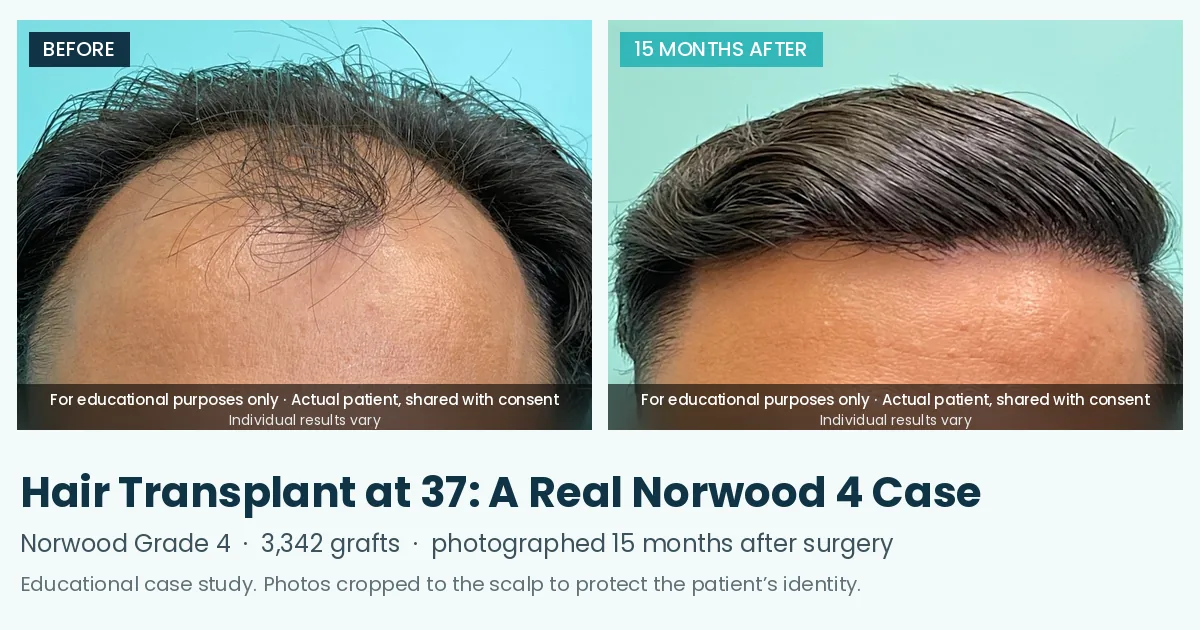
A real case from our clinic: a 37-year-old man with Norwood Grade 4 hair loss across the front, temples and middle of the scalp, photographed 15 months after his hair transplant.
Quick answer: Yes, a hair transplant can restore Norwood Grade 4 hair loss at 37 when the donor area is strong, even after years of medicines have given little improvement. In this case, 3,342 grafts were placed across the hairline, temples and mid-scalp using EnRiched-FUE™, with 420 single-hair grafts forming the hairline. The surgery took about 6.5 hours, recovery was uncomplicated, and at 15 months the result is mature: the front and top are covered when seen from the front and from above. Results depend on donor quality, planning and aftercare, and vary from person to person.
Actual SkinQure Hair Transplant patient. The photographs on this page are of a real patient treated at SkinQure Hair Transplant by Dr. Jangid, published with his written consent. They have been cropped to the hair and scalp, and the face has been removed and blurred so he cannot be identified.
What the Patient Came In With
The patient, a 37-year-old man, had been losing hair for about five years. He had taken hair loss medicines for most of that time, with only minimal improvement, and had no other medical conditions. By the time he came to Dr. Jangid, his hairline had moved well back, the temples had receded, and the hair through the middle of his scalp had thinned. Seen from above, the scalp showed clearly from the hairline to the mid-top, with only a sparse tuft left at the front.
This is a common story: medicines can slow hair loss and help some men regrow hair, but where follicles have already shrunk a long way, they often cannot bring back a receded hairline on their own.
What We Found on Assessment
On Examination
- Norwood Grade 4 male pattern hair loss: a receded hairline with hair loss across the front, temple recession and thinning in the mid-scalp.
- No crown involvement: there was no hair loss or thinning at the crown, and the remaining hair was normal.
- A very good donor area: high hair density at the back and sides, thick individual hairs and a normal, healthy scalp.
Under the Scalp Microscope (Trichoscopy)
Dr. Jangid examined the frontal scalp with a dermatoscope, a test called trichoscopy. It showed:
- Fine, miniaturised hairs and very few normal-thickness hairs in the frontal area: the typical sign of male pattern hair loss.
- Tiny yellow-white dots, which mark follicles where hair used to grow.
- No scarring, a clear scalp, and only mild dandruff.
The absence of scarring matters: it confirms the loss is androgenetic alopecia rather than a scarring condition, in which a transplant may not take well.
Before Surgery
Routine blood investigations were done and were normal, and no other condition was found apart from hair loss. Assessment: male pattern hair loss (androgenetic alopecia), Norwood Grade 4, with a donor area able to support a large single session. See the Norwood scale explained for how the grades are defined.
Case at a Glance
| Age / sex | 37 years, male |
|---|---|
| Hair loss history | About 5 years; medicines for 5 years with minimal improvement |
| Hair loss grade | Norwood Grade 4 (front, temples and mid-scalp; crown not affected) |
| Trichoscopy | Miniaturised hairs, yellow-white dots, no scarring |
| Donor area | Very good: high density, thick hair, normal scalp |
| Technique | EnRiched-FUE™ |
| Areas treated | Front (hairline), temples and middle of the scalp |
| Total grafts | 3,342 |
| Hairline (transition zone) | 420 single-hair grafts; 95–100% of the hairline made with singles |
| Planned density | Up to 35–40 grafts/cm² at the front, tapering gradually behind |
| Procedure time | About 6.5 hours in the operation theatre |
| After surgery | No complications; mild swelling for 2–3 days |
| Aftercare | Excellent; regular follow-up and medicines as advised |
| Supportive treatment | Topical medication, plus PRP once a month |
| Result shown | 15 months after surgery |
Before and After: 15-Month Result
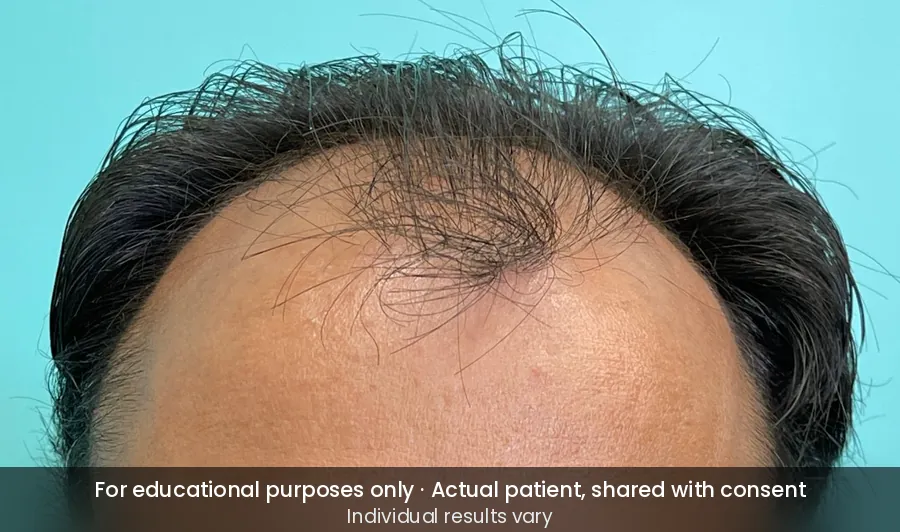
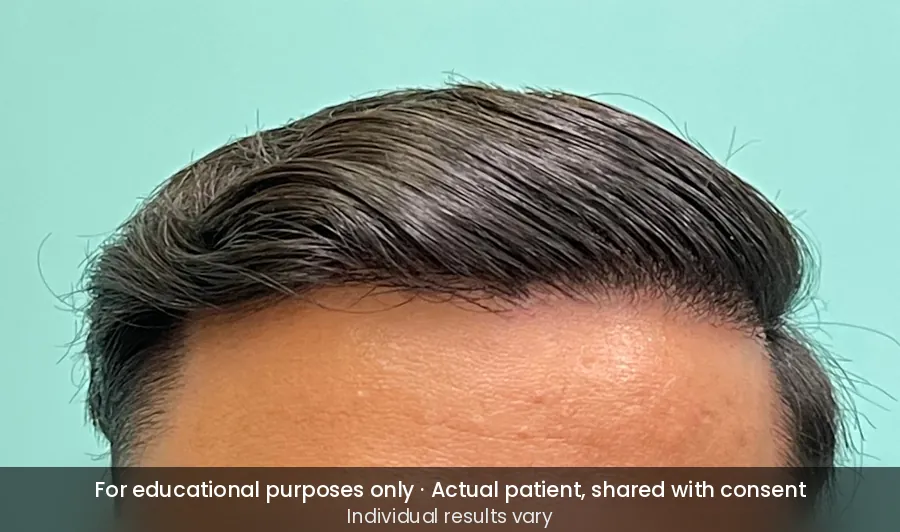
Front view. Before: the hairline had receded deeply at the front and both temples, leaving a sparse tuft in the centre. At 15 months: a new, even hairline runs across the forehead, and the temples have been rebuilt with a soft, natural edge.
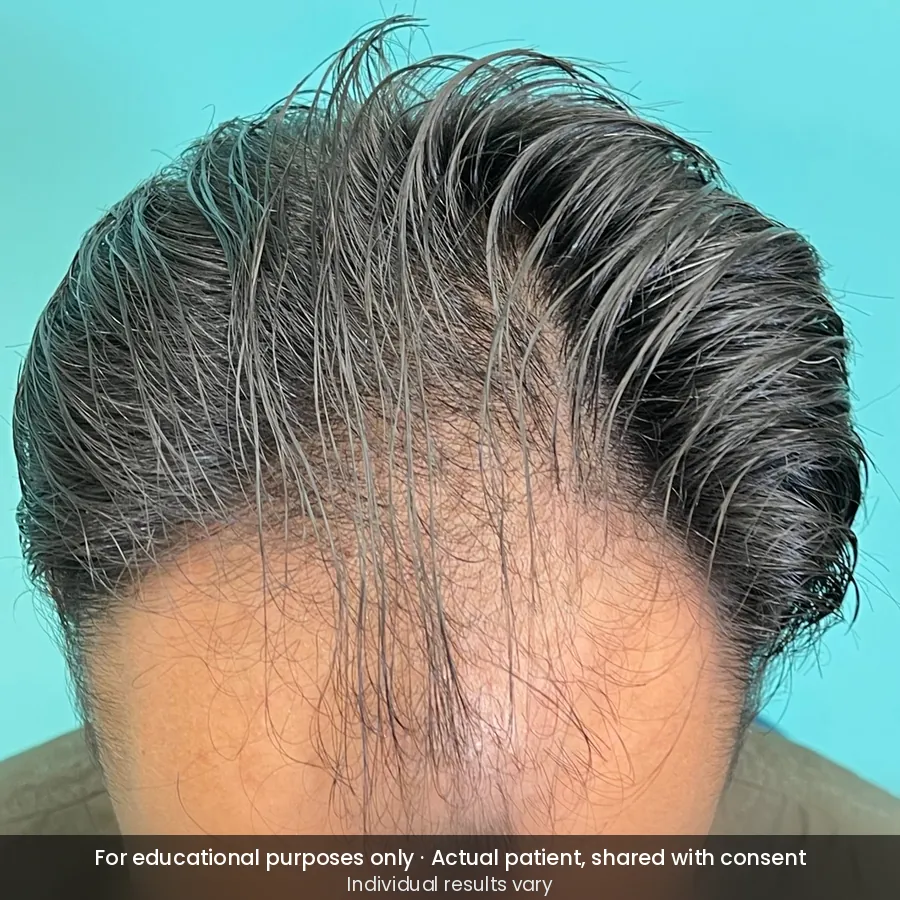
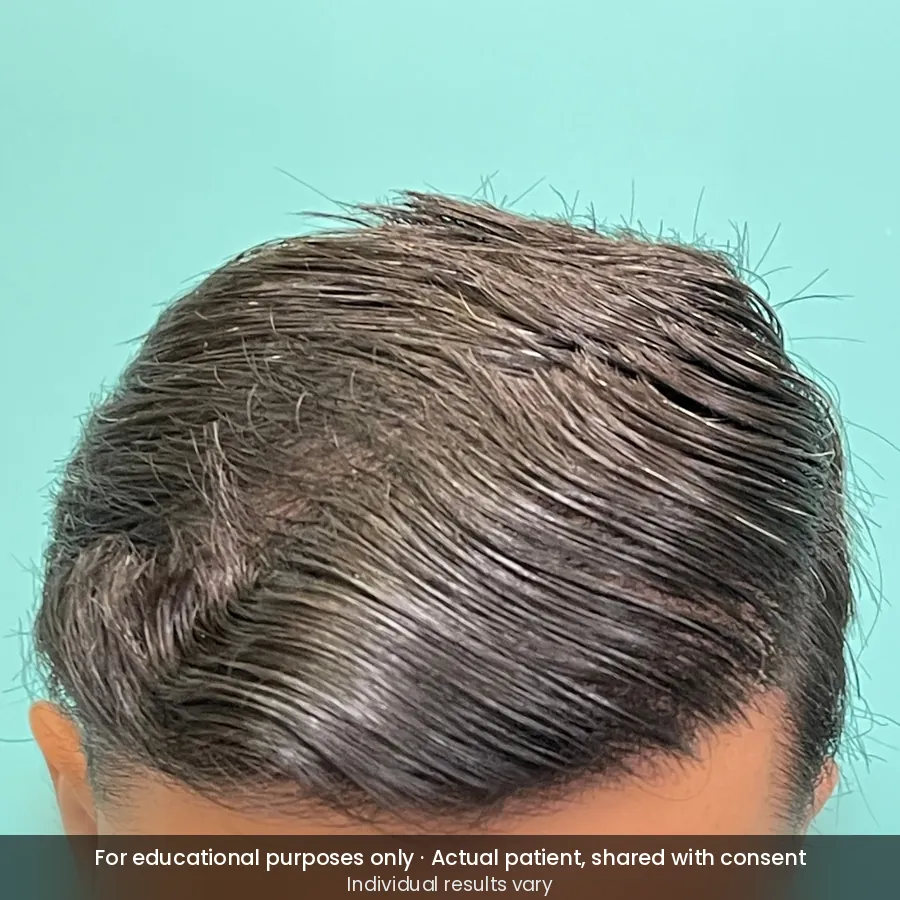
Top view. Before: the scalp showed through from the hairline to the middle of the head. At 15 months: the front and mid-scalp are covered, and the hair can be styled back without the scalp showing.
Image disclaimer: These are actual SkinQure Hair Transplant patient photographs, reproduced strictly for educational purposes with the patient's written informed consent. They have been cropped to the hair and scalp, the face has been removed and blurred to protect his identity, and they are otherwise unretouched. Both sets were taken at the clinic against the same background. They show one patient's result; they are not a prediction of yours, and individual results vary. Please consult a qualified doctor for an assessment of your own hair loss.
Why 3,342 Grafts? The Size of the Area Decides
Graft numbers are often quoted without context. What actually decides them is how much scalp needs covering and how dense it needs to look. In this case three zones needed work:
- The hairline, rebuilt from scratch across the forehead.
- Both temples, which had receded deeply.
- The mid-scalp, which had thinned enough for the scalp to show from above.
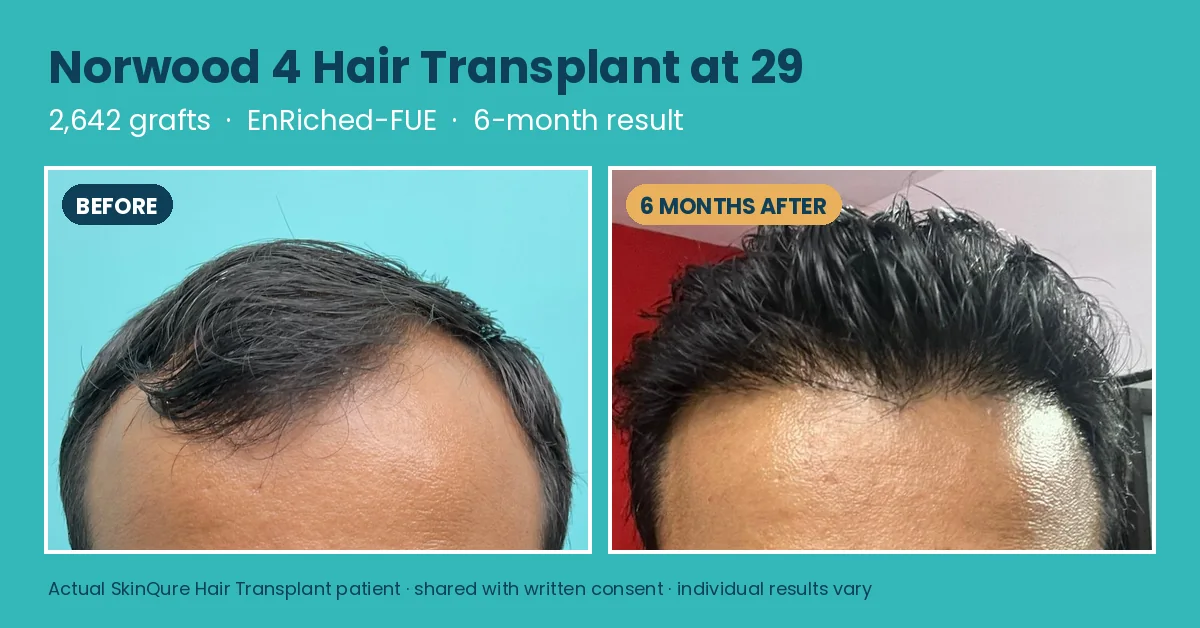
Rebuilding only a hairline might take far fewer grafts. Covering the hairline, temples and the middle of the head at a natural density took 3,342. Compare this with our Norwood 4 case at 29 with 2,642 grafts, where the mid-scalp loss was milder. Same grade, different area, different graft count. To get a rough idea for your own scalp, try the graft calculator.
Why the Donor Area Made a Large Session Possible
A hair transplant moves hair; it does not create new hair. Grafts come from the back and sides of the head, where follicles are naturally resistant to male pattern hair loss. Taking more than 3,000 grafts in one sitting is only sensible when that donor area is dense enough to give them without looking thin afterwards.
This patient's donor area was very good on all three counts that matter: high density, thick individual hairs and a healthy scalp. Thick hair also covers more scalp per graft, which is part of why the top view looks full at 15 months.
How the Plan Was Made
1. A Hairline That Suits a Man in His Late Thirties
At 37, a low, straight, teenage hairline would look out of place, and it would look more so in ten years. Dr. Jangid drew an age-appropriate hairline at a natural height for his age and face, with a gently zigzag edge rather than a ruler-straight line. Read more about hairline design.
2. Single-Hair Grafts at the Front Edge
Natural hairlines begin with fine single hairs and get denser behind them. Of the 3,342 grafts, 420 single-hair grafts were placed in the transition zone, and 95–100% of the hairline itself was made with singles. This keeps the front edge soft rather than “pluggy”, which you can see in the 15-month front view.
3. Density at the Front, Tapered Through the Top
Grafts were placed at up to 35–40 grafts per cm² at the front, where density is most visible, and then tapered gradually through the temples and mid-scalp. This puts grafts where they make the biggest visible difference while still giving the top of the head real coverage.
The planning principle, in one line: match the graft count to the area, the hairline to the age, and the density to where people actually look.
What the Treatment Involved
Step 1: Assessment and Planning
Dr. Jangid graded the hair loss, examined the donor area for density, hair thickness and scalp health, and marked the hairline and treatment zones before surgery. Blood was also drawn on the day to prepare PRP.
Step 2: Comfortable Anaesthesia
A numbing cream was applied first to reduce discomfort from the anaesthetic injections. Local anaesthesia was then given with small pricks, so the patient stayed awake and comfortable throughout.
Step 3: Slits First, Then Extraction and Implantation Together
The recipient sites (slits) were made first with fine needles, following the planned hairline and density map. Graft extraction from the donor area started after that, and implantation was done alongside extraction, so each graft spent as little time outside the body as possible.
This is the core of FUE (follicular unit extraction) with EnRiched-FUE™, SkinQure's FUE technique: individual follicular units, natural groups of one to four hairs, are taken from the donor area, treated with growth factors and implanted soon after extraction rather than stored for long periods. The 3,342-graft session took about 6.5 hours in the operation theatre. There was no bleeding problem, no complication, and the patient was comfortable at the end.
Step 4: Supportive Treatment
A transplant does not stop male pattern hair loss in the hair that was already there. Medicines to support his existing hair were started in the first week, and PRP (platelet-rich plasma) was added once the post-surgery shedding phase was over, continuing once a month alongside a topical medication.
This Patient's Recovery, Step by Step
| When | What we saw |
|---|---|
| Just after surgery | No bleeding; patient comfortable |
| Day 2 | Swelling, but no pain; crusts starting to form; no infection; scalp cleaned; donor area healing well |
| Day 4 | First dressing; swelling reducing, no pain; crusts drying; no infection; medicines started for existing hair |
| Month 2 | Shedding phase over; about 5–10% of new hair visible; scalp clean; PRP added |
| Month 5 | About 50–60% of the hair growing; the frontal area was already largely covered; donor area completely normal |
| Month 15 | Mature result: hairline, temples and mid-scalp covered (photos above) |
His aftercare was excellent: he followed instructions, took his medicines and came regularly for follow-up, which played a real part in how smoothly he recovered.
What 15 Months Tells You That 6 Months Cannot
Many before-and-after photos are taken at 6 months, when new hair has appeared but is still fine and growing. By 12–15 months, the transplanted hairs have thickened and matured, so what you see is close to the long-term result.
| When | What usually happens |
|---|---|
| First few days | Small scabs in the recipient area; mild swelling for 2–3 days is common |
| Weeks 2–6 | Many transplanted hairs shed. This is expected: the follicle stays in place and regrows |
| Months 3–4 | New hairs begin to appear, often fine at first |
| Month 6 | Visible coverage; hairs are still thin and thickening |
| Months 9–12 | Most of the final density and texture is usually visible |
| Months 12–18 | Hairs finish thickening; the result is considered mature, as in this case at 15 months |
For more detail, read the hair growth timeline after a hair transplant.
An Honest Caveat
A hair transplant is not right for everyone with Grade 4 loss, and it is not a one-time cure. Native hair can keep thinning after surgery, which is why supportive treatment and follow-up continue, and why some people need a second procedure years later. A weak donor area, rapidly progressing loss or certain scalp conditions can make a large session unsuitable. This patient's result also reflects his own hair quality and consistent aftercare. See are you eligible for a hair transplant?
When a Transplant Makes Sense, and When to Wait
| A transplant is often a good option when… | It may be better to wait or treat medically first when… |
|---|---|
| Hair loss has reached a visible, fairly stable stage, such as Norwood 3–5 | Loss is very early or still progressing rapidly |
| The donor area is dense, with healthy hair | The donor area is thin or also affected |
| The scalp is healthy | There is active scalp disease or unexplained shedding |
| Expectations are realistic about density and timeline | The goal is a teenage hairline or a guaranteed final density |
| The patient is willing to continue supportive treatment | Diffuse thinning has another cause that needs treating first |
Where This Case Stands
At 15 months, the patient's hairline, temples and mid-scalp are covered, with a soft front edge that suits his age. He continues topical medication and monthly PRP to protect his native hair.
Compare other Norwood 4 cases at SkinQure: Norwood 4 at 29, 2,642 grafts, Norwood 4, 3,150 grafts and Norwood 4, 2,800 grafts, or browse all hair transplant case studies. For pricing factors, see hair transplant cost in Delhi, and for more on this stage, Grade 4 male pattern baldness.
Thinning at the front and top? Not sure if a transplant is right for you? Request a consultation with Dr. Jangid at SkinQure Hair Transplant, Saket and Punjabi Bagh, New Delhi.
FAQs
1. Is 37 a good age for a hair transplant?
For many men it is. By the late thirties the pattern of hair loss is usually clearer and more predictable than in the twenties, which makes planning easier. Age alone does not decide it: donor quality, how stable the loss is and realistic expectations matter more.
2. Why did this patient need 3,342 grafts?
The treated area was large. It covered the hairline, both temples and the thinning middle of the scalp, not just the front edge. Covering the mid-scalp at a natural density takes more grafts than rebuilding a hairline alone.
3. Is the 15-month result the final result?
It is close to it. Most of the final density and texture is usually visible by 12 months, and hairs can keep thickening slightly up to about 15–18 months. At 15 months this patient's result is considered mature.
4. Can a hair transplant cover the middle of the scalp, not just the hairline?
Yes, if the donor area can supply enough grafts. In this case grafts were placed across the front, temples and mid-scalp, with the highest density at the front and a gradual taper behind it.
5. How long does a 3,000-plus graft session take?
It depends on the technique and the team. This 3,342-graft EnRiched-FUE session took about 6.5 hours in the operation theatre, done in a single day under local anaesthesia.
6. Will the transplanted hair fall out again later?
Transplanted follicles come from the back and sides of the head, which are resistant to male pattern hair loss, so they usually keep growing long term. The native hair around them can still thin, which is why supportive treatment continues.
7. What is EnRiched-FUE™?
It is SkinQure's FUE hair transplant technique. Grafts are implanted soon after they are extracted, and they are treated with growth factors before implantation.
8. Do I still need medication or PRP after a transplant?
Often, yes. The transplanted hair is resistant to male pattern hair loss, but your existing hair is not. This patient used a topical medication and monthly PRP to help protect it. Your doctor will advise what suits you.
9. How much does a 3,000-graft hair transplant cost in Delhi?
Cost depends mainly on the number of grafts, the technique and the planned density. Hair transplant prices in Delhi broadly range from about ₹50,000 to ₹5,00,000. An exact estimate needs an assessment of your donor area and the area to be covered. See hair transplant cost in Delhi.
10. I have taken hair loss medicines for years with little improvement. Can a transplant still help?
Often, yes. This patient had taken medicines for about five years with minimal improvement. Medicines mainly protect and strengthen existing hair; they usually cannot regrow a hairline where follicles have shrunk a long way. A transplant moves healthy follicles into those areas, and medicines then help protect the native hair around them.
Disclaimer: These images feature actual patients of SkinQure and are shared with their informed consent for educational and awareness purposes. Individual results may vary depending on hair loss patterns, donor area, and overall health. Similar outcomes cannot be guaranteed.
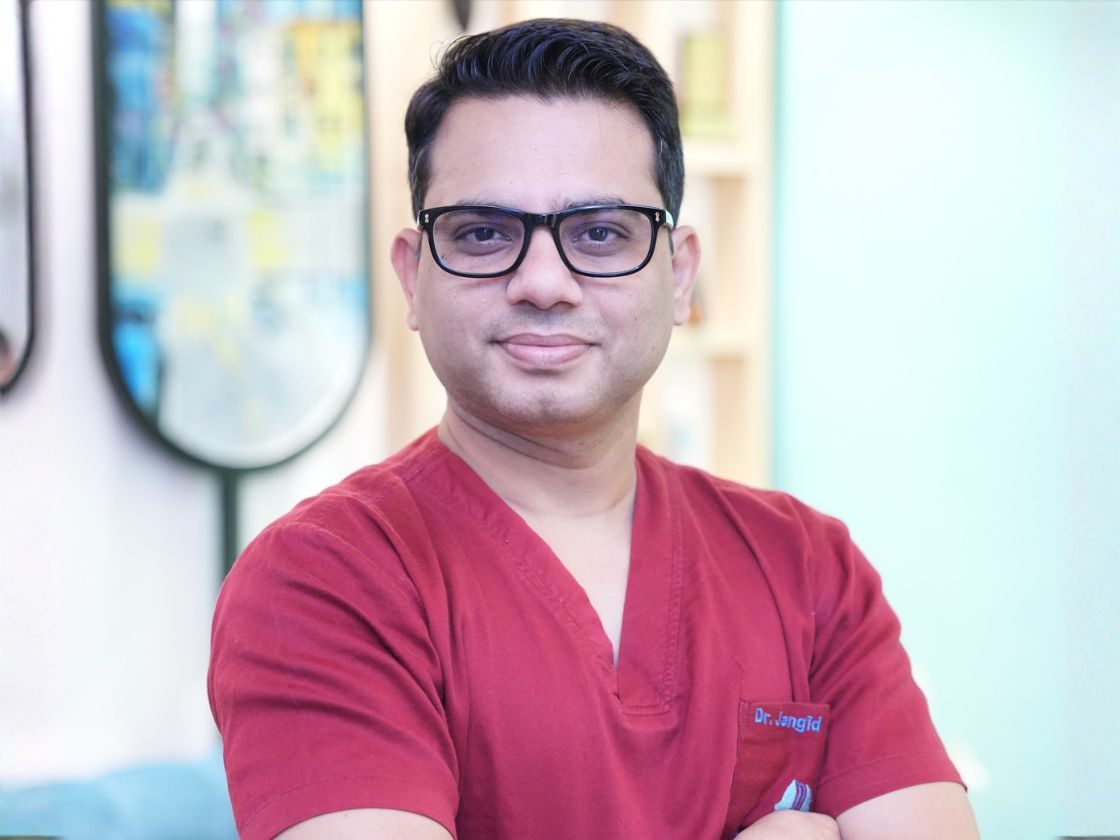
Dr. Jangid
Senior Dermatologist & Hair Transplant Surgeon, Ex-Senior Resident at AIIMS, with 18+ years of experience and the originator of the EnRiched-FUE™ approach.
Dr. Jangid, MD - Dermatology, Venereology & Leprosy, MBBS
Registered medical practitioner: Rajasthan Medical Council 025648 · Delhi Medical Council 40715 · Medical Council of India MCI-IMR/09/163